
Your marble floors used to reflect the sunlight coming through your villa’s large windows. Now they look dull, scratched and unevenly coloured. Perhaps you have considered replacing the entire floor. But what if the original marble could be restored instead?
Marble is one of the most recognisable flooring materials in luxury properties across Marbella, Puerto Banús, Nueva Andalucía, Benahavís, Benalmádena and the Costa del Sol.
You’ll find it in entrance halls, living rooms, staircases, bathrooms and spacious terraces.
Over time, however, even attractive natural stone can lose its original appearance through wear, scratches, staining, chemical damage and unsuitable cleaning methods.
The good news? Many dull marble floors can be improved significantly through professional restoration.
But not every problem requires the same treatment, and not every damaged floor can be made perfect again.
This guide explains what professional marble polishing actually involves, how much different treatments may cost and how to protect stone flooring in Marbella’s coastal environment.
Quick answer: Light surface dullness may respond to professional cleaning and suitable finishing treatments. More extensive scratches, etching and unevenness may require diamond honing or polishing. Cracked, unstable or moisture-damaged floors need further assessment before restoration.
Why Do Marble Floors Lose Their Shine?
Marble is a natural stone formed primarily from minerals such as calcite or dolomite.
It can be polished to an attractive reflective finish, but its surface is also vulnerable to certain acids, abrasion and physical damage.
A marble floor may appear dull for several different reasons.
Daily Foot Traffic
Over time, shoes, fine dust and grit can create microscopic scratches across the polished surface.
Busy entrance halls and living areas often show wear first.
Unsuitable Cleaning Products
Acidic products such as vinegar, lemon-based cleaners or certain bathroom descalers can etch susceptible marble.
The resulting dull patches may not disappear through ordinary washing.
Sand and Outdoor Dirt
Sand carried indoors from beaches and terraces can act as an abrasive under shoes and furniture.
This is particularly relevant for coastal homes with frequent terrace access.
Furniture Movement
Dragging chairs, tables or heavy furniture across marble can cause scratches and localised damage.
Protective pads and appropriate handling help reduce the risk.
Moisture and Staining
Certain oils, coloured liquids and moisture-related problems can affect the appearance of stone.
The cause must be identified before selecting treatment.
Previous Surface Treatments
Inappropriate coatings, waxes or repeated cleaning-product residues may leave a cloudy or uneven appearance.
A professional should assess the existing finish before proceeding.
Dullness Is Not Always a Stain
Imagine spilling lemon juice on a polished marble floor.
After cleaning the liquid, you notice a pale, matte-looking ring.
The surface may have experienced etching: an acid-related change to the stone’s finish.
This is different from a stain caused by coloured material penetrating the stone.
A stain may require an appropriate removal treatment, while etching may require refinishing.
The Natural Stone Institute explains these distinctions and recommends professional restoration for deeper scratches and difficult damage.
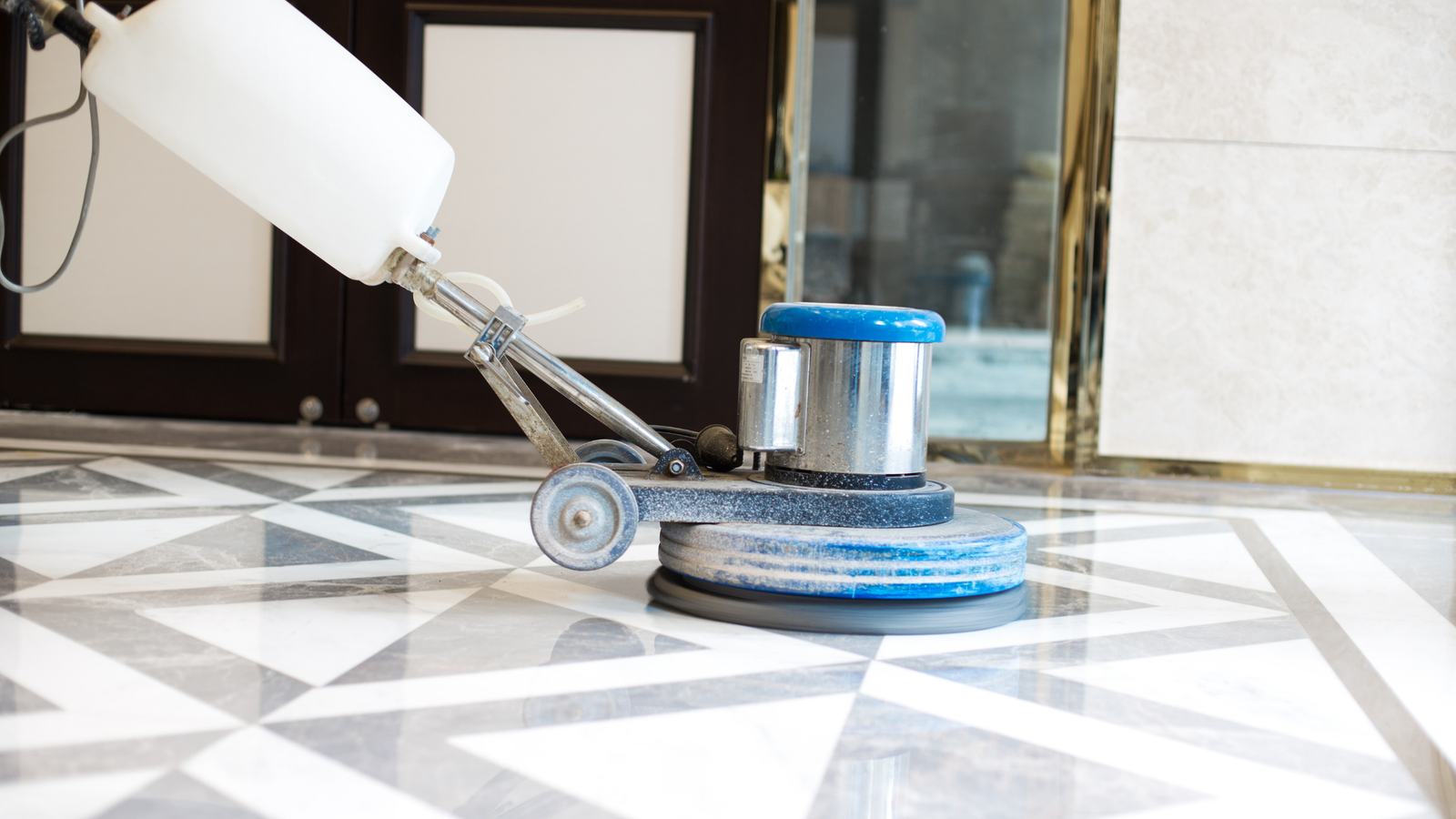
Marble Polishing, Honing and Crystallisation: What’s the Difference?
Property owners often use the expression “polishing the marble” to describe several different processes.
In reality, the correct treatment depends on the amount and type of damage.
1. Professional Marble Cleaning
A professional may first remove dirt, grease, residue and unsuitable previous cleaning products.
In some cases, this alone improves the floor’s appearance.
However, cleaning cannot remove deeper scratches or restore stone that has been etched.
2. Abrillantado: Restoring Surface Shine
Abrillantado generally refers to treatments designed to improve the shine of an existing floor.
It may be suitable where the marble is structurally sound and surface wear is relatively light.
The specific process varies between service providers.
Ask whether the treatment involves mechanical polishing, a chemical finishing process, a coating or another method.
3. Pulido and Diamond Honing
When the floor has more significant wear, a specialist may use diamond abrasives to remove a controlled amount of the damaged surface.
This process can help reduce visible scratches, etching and certain uneven areas.
Different abrasive grades are used progressively to create the desired finish.
Marbella-based Filo Pulimentos describes the use of diamond discs of different grades for floor restoration.
Important: Mechanical resurfacing removes some stone. Repeated aggressive grinding is not suitable for every installation.
4. Crystallisation
Cristalizado is a specialised chemical-mechanical finishing treatment used by some marble-floor professionals.
It can increase surface gloss, but suitability depends on the stone, previous treatments, intended use and desired finish.
It should not be presented as a universal replacement for proper honing or repairs.
Ask the specialist to explain the process and demonstrate the proposed finish.
5. Sealing the Stone
Some natural stones benefit from a compatible penetrating sealer that helps reduce absorption of certain liquids.
However, sealing does not make marble scratch-proof or resistant to acid etching.
Not all installations need the same treatment. The stone’s porosity, existing finish and intended use matter.
Ask your specialist whether sealing is advisable for your particular floor.
Marbella homeowner tip: Before treating an entire villa floor, request a small demonstration in a suitable area. This can help establish the finish that is realistically achievable.
Should You Choose a Mirror Finish or a Softer Honed Finish?
High-gloss marble can create an elegant appearance in large living rooms and entrance halls.
A honed finish offers a softer, less reflective appearance.
The right choice depends on the original material, architectural style and how the area will be used.
Particular attention is needed in bathrooms, entrances and areas exposed to moisture.
A glossy appearance is not proof that a floor meets appropriate slip-resistance requirements.
Ask the specialist about the relevant safety characteristics before changing the finish in wet or frequently used areas.
How Much Does Marble Floor Polishing Cost in Marbella in 2026?
Marble restoration is commonly priced according to the area, condition of the stone and treatment required.
Published Spanish market estimates provide the following broad planning ranges:
| Treatment | Indicative Price | Typical Application |
|---|---|---|
| Abrillantado or crystallisation | €8–€15/m² | Surface shine improvement where major restoration is unnecessary |
| Full mechanical polishing | €15–€30/m² | Worn, scratched or etched marble requiring abrasive treatment |
| Grinding and levelling | €30–€50/m² | More extensive unevenness or damage requiring additional stages |
| Repairs or specialist stain removal | Individually quoted | Chips, cracks, difficult stains and damaged tiles |
Indicative 2026 Spanish-market estimates published by Solo Alta Gama . They are not fixed Marbella tariffs or Vista quotations. Small jobs, access, minimum charges, material condition and VAT can alter the final price.
Example: Restoring 80 m² of Marble Flooring
Imagine an apartment in Nueva Andalucía with 80 m² of marble flooring.
The floor is dull from daily wear, with moderate surface scratching, but without major structural damage.
If a specialist determines that full polishing is suitable, the indicative calculation would be:
| Calculation | Estimated Amount |
|---|---|
| 80 m² × €15/m² | €1,200 |
| 80 m² × €30/m² | €2,400 |
| Indicative treatment range | €1,200–€2,400 |
This illustration excludes any separately charged repairs, specialist stain removal, moving furniture, minimum call-out fees and applicable VAT.
The real quotation should be based on the actual condition and accessible floor area.
What Can Make the Price Higher?
- Deep scratches requiring several abrasive stages
- Uneven stone tiles or damaged joints
- Small rooms with difficult machine access
- Multiple staircases or complex edges
- Heavy furniture requiring relocation
- Extensive staining or previous coatings
- Repairs to chipped or cracked stone
- Special protective or finishing treatments
Is Restoration Cheaper Than Replacing Marble?
Often it can be, particularly when the existing installation is structurally sound and the damage is primarily cosmetic.
Replacement may involve demolition, waste removal, new stone, installation, skirting and finishing work.
However, restoration is not always the appropriate solution. Loose tiles, serious moisture damage or severely compromised stone may require repairs or replacement.
Want to Restore Your Marble Floors Without Replacing Them?
Tell us where your property is located, the approximate floor area and what problems you’ve noticed. Vista can help connect you with independent marble polishing and stone restoration professionals on the Costa del Sol.
Request a Marble Restoration Quote →Free Enquiry · No Obligation · Marbella & Costa del Sol
Can Scratches, Stains and Cracks Be Removed from Marble?
The answer depends on the type and severity of damage.
Some problems affect only the polished surface. Others extend deeper into the stone or originate beneath the floor.
| Problem | Possible Treatment | Important Limitation |
|---|---|---|
| Light surface dullness | Professional cleaning or suitable polishing | The original finish must be assessed |
| Fine scratches | Localised honing or polishing | Matching the surrounding finish can be challenging |
| Deep scratches | Mechanical restoration or specialist repair | Not all stone thicknesses permit aggressive grinding |
| Acid etching | Suitable refinishing or repolishing | Normal cleaning will not restore an etched finish |
| Oil or coloured stains | Appropriate stain treatment or poultice | Some deep stains may remain |
| Cracked or loose tiles | Repair or replacement after investigation | Polishing alone cannot stabilise a defective floor |
| White powdery deposits | Moisture investigation and appropriate treatment | Underlying water movement may require correction |
Be Careful with Stain-Removal Products
Some online instructions recommend strong chemicals for treating marble stains.
But products suitable for one type of stone or stain may damage another surface.
Before using solvents, oxidising products or commercial stain removers, identify the material and obtain appropriate professional guidance.
Never mix cleaning chemicals. Follow product safety instructions and avoid untested treatments on valuable flooring.
Reference: Natural Stone Institute — Removing Stains from Stone .
When Polishing Is Not the Solution
If marble tiles are lifting, cracking repeatedly or developing moisture-related marks, address the underlying problem first.
A new polished surface will not repair a leaking pipe, failed waterproofing or unstable substrate.
Persistent white mineral deposits can indicate efflorescence, which may be associated with water moving through the installation.
The Natural Stone Institute recommends investigating persistent moisture-related deposits rather than repeatedly washing them away.
Why Marble Floors Need Special Attention on the Costa del Sol
Marble flooring is common in Mediterranean-style villas and apartments, partly because natural stone provides an elegant appearance and a comfortable surface in warm weather.
But coastal properties introduce several maintenance considerations.
Sand Carried Indoors from Beaches and Terraces
A villa near Puerto Banús or an apartment on the Golden Mile may have frequent movement between indoor rooms and outdoor spaces.
Fine sand and grit can be carried inside on shoes or beneath furniture.
Regular dry dust removal and entrance mats can help reduce abrasive wear.
Sea Air and Indoor Moisture
Salt air does not automatically damage every indoor marble floor.
However, properties near the coast may experience salt deposits on exterior surfaces, changing humidity and moisture-related maintenance issues.
Where there is persistent dampness, condensation or water penetration, identify the source before applying new floor treatments.
Read our related guide: Why Coastal Homes Need Different Cleaning Routines .
Holiday Rentals and Heavy Use
A private second home used a few months each year may experience different floor wear from a busy holiday rental.
Frequent guest turnover, luggage movement, sand and furniture use can increase abrasion and cleaning demands.
For high-use properties, the cleaning plan should include suitable stone-care procedures rather than relying on strong multipurpose chemicals.
Related reading: What Does Airbnb Management Really Cost Here? .

How to Keep Marble Floors Looking Beautiful for Longer
Professional restoration may improve a worn floor, but long-term results depend heavily on proper maintenance.
A suitable routine should focus on preventing abrasion, controlling moisture and avoiding damaging chemicals.
Seven Simple Marble Care Rules
- Remove grit regularly. Use a soft dust mop or suitable vacuum before wet cleaning.
- Choose appropriate cleaners. Use products intended for the specific natural stone.
- Avoid acidic products. Vinegar, lemon juice and unsuitable bathroom descalers may etch marble.
- Avoid excessive water. Use an appropriate damp-cleaning method and dry where needed.
- Protect furniture contact points. Use suitable pads beneath chairs and tables.
- Clean spills promptly. Particularly oils, coloured liquids and acidic substances.
- Investigate recurring problems. Repeated marks, loose tiles or persistent dampness may require more than cleaning.
The Natural Stone Institute’s Care and Cleaning Guide recommends suitable neutral cleaners and careful maintenance of natural stone.
What Should You Never Use on Marble Flooring?
Unless a qualified stone specialist specifically approves a method, avoid:
- Vinegar or acidic descaling products
- Lemon-based cleaning solutions
- Abrasive scouring pads
- Unsuitable bathroom cleaners
- Strong chemical mixtures
- Unverified polishing powders
- Excessive water left standing
For marble floors in holiday villas: Provide cleaning staff with a simple written maintenance procedure, including approved products and the correct method for handling spills.
Consistent cleaning is usually more useful than repeatedly correcting avoidable surface damage.
Where to Find Marble Polishing Specialists in Marbella
If the floor has significant scratches, dull areas, etching or uneven tiles, professional assessment is a sensible starting point.
The following companies publicly advertise stone polishing and restoration services in Marbella or the surrounding Costa del Sol.
These are independent research options, not claims that they are verified Vista partners.
Filo Pulimentos — Marbella
Marbella-based specialist offering marble polishing, grinding, crystallisation, diamond treatments and restoration.
Its website explains the differences between polishing damaged floors and lighter shine treatments.
Pulidos Sol — Costa del Sol
Specialist floor restoration company advertising marble, terrazzo and natural-stone polishing services across Marbella, Estepona and surrounding areas.
Pulimentos Fuengirola Díaz
Floor polishing and restoration specialist based in Fuengirola, serving properties along the Costa del Sol.
Relevant for owners in Fuengirola, Benalmádena, Mijas Costa and nearby areas.
Ask the provider for current service coverage and the appropriate treatment for your floor.
Natural Stone Institute
International industry resource covering natural-stone care, cleaning, stains, material identification and maintenance.
Useful for understanding why different stones respond differently to chemicals and restoration techniques.
Verify current service areas, insurance, experience, pricing, the proposed technique and the contracting entity before proceeding.
What to Ask Before Hiring a Marble Restoration Company
- What material is my floor actually made of? Confirm whether it is marble, limestone, travertine, terrazzo, porcelain or another surface.
- What is causing the dull appearance? Request an explanation of wear, staining, etching or coating residue.
- Which treatment do you recommend? Ask whether the work involves cleaning, honing, polishing, crystallisation or repairs.
- Can you show a sample result? A small test area helps establish realistic expectations.
- How will you protect walls and furniture? Discuss equipment access, dust, water, skirting and surrounding finishes.
- Are repairs included in the price? Clarify how cracks, chips, stains and loose tiles will be handled.
- How long will the work take? Ask when furniture can be returned and when the floor can be safely used.
- What maintenance is recommended afterward? Request written guidance about approved cleaners and appropriate care.
- What is the full quotation? Confirm accessible square metres, minimum charges, extras and VAT.
Can You Arrange Marble Restoration While Living Abroad?
Many homeowners in Marbella and Benalmádena live outside Spain for part of the year.
If your marble floors need attention, you may prefer to arrange restoration before your next visit or between holiday rental bookings.
However, remote projects require clear coordination.
A Practical Remote Restoration Plan
- Send clear photographs showing the overall floor and damaged areas.
- Provide approximate square metres and property location.
- Arrange an on-site technical assessment before accepting the final quotation.
- Agree the restoration process and expected finished appearance.
- Confirm access, furniture movement and protection of surrounding surfaces.
- Request photographs or video documentation of the completed work.
- Arrange final cleaning and a suitable handover inspection.
If the property will remain empty for several weeks, consider combining restoration with routine inspections and other property maintenance.
Read our related guide: Own a Holiday Villa Abroad? Avoid These Problems .
If your flooring works form part of a larger refurbishment, explore: Renovating a Marbella Villa: Costs Nobody Mentions .
Marble Floor Polishing: Common Questions
Can dull marble floors really look new again?
Many dull marble floors can be improved significantly through appropriate professional restoration. The result depends on the stone type, thickness, damage and existing installation. Perfect restoration is not guaranteed.
What is the difference between polishing and crystallisation?
Mechanical polishing uses abrasives to refine the stone surface. Crystallisation is a specialised finishing treatment used on certain compatible calcareous stones. The correct method depends on the floor’s condition.
How much does marble polishing cost per square metre?
Published 2026 Spanish estimates suggest approximately €8–€15/m² for lighter shine treatments and €15–€30/m² for full polishing, with more complex restoration costing more. Obtain an individual Marbella quotation.
Does marble sealing prevent all stains?
No. A suitable impregnating sealer may reduce absorption of certain liquids, but it cannot prevent all staining and does not stop acid etching or physical scratching.
Can I use vinegar to clean marble?
No. Vinegar is acidic and can etch susceptible marble and limestone. Use appropriate natural-stone cleaners.
How long does marble restoration take?
The duration depends on the floor area, access, damage and treatment. Some residential projects take one or two working days, while larger or more complex projects require longer. Ask the contractor for a specific programme.
Is polished marble suitable for bathrooms?
The finish must be assessed for its intended use and relevant slip-resistance requirements. Do not assume a highly polished surface is appropriate in a wet area.
Can Vista arrange marble polishing?
Vista Property Management Marbella acts as a service-matching intermediary. We help homeowners submit their requirements and connect with independent local stone restoration professionals, subject to availability.
Bring Back the Beauty of Your Marbella Marble Floors
From elegant entrance halls to spacious villa living rooms, marble deserves appropriate care. If your floors have lost their shine, Vista can help you request quotations from independent local specialists for inspection, polishing and restoration.
Request a Free Marble Polishing Quote →Marbella · Benalmádena · Fuengirola · Costa del Sol
Reliable Marble Care and Restoration Resources
- Natural Stone Institute — Care and Cleaning
- Natural Stone Institute — Stain Identification and Removal
- Natural Stone Institute — Understanding Marble
- Natural Stone Institute — Stone Sealing Guidance
- Solo Alta Gama — Marble Polishing and 2026 Price Examples
- Filo Pulimentos Marbella — Restoration Methods
Editorial note: Information reviewed November 2026. Price ranges are indicative published Spanish-market estimates, not fixed local quotations. The correct restoration technique depends on the actual material, its condition, previous treatments and intended use. Have the floor assessed by a competent specialist before abrasive treatment, chemical crystallisation or sealing. Vista Property Management Marbella operates as a service-matching intermediary and does not directly provide marble polishing, stone restoration or technical certification.